Finding users where they already were: a resume feature that drove 62% adoption and 3× retention
I led the design of a resume feature that helped early-career job seekers surface missing experiences, tighten loose writing, and build a stronger resume through guided AI.
Impact
Adoption
62%
Nearly 2× higher than our previous best.
Retention lift
3×
~50% of users stayed by Day 10, ~30% by Day 30 (vs <10% before).
First action
Top action
New users tried it soon after signup.
- My role
- Product Design, User Interviews, Research Synthesis, Cross-Functional Alignment
- Team
- CEO, Head of Growth, Head of Customer Success, 2 Engineers
- Timeline
- Feb 2025 – Mar 2025
- Company
- nSpire AI uses AI to help college students and early-career professionals secure their dream jobs.
The shipped experience
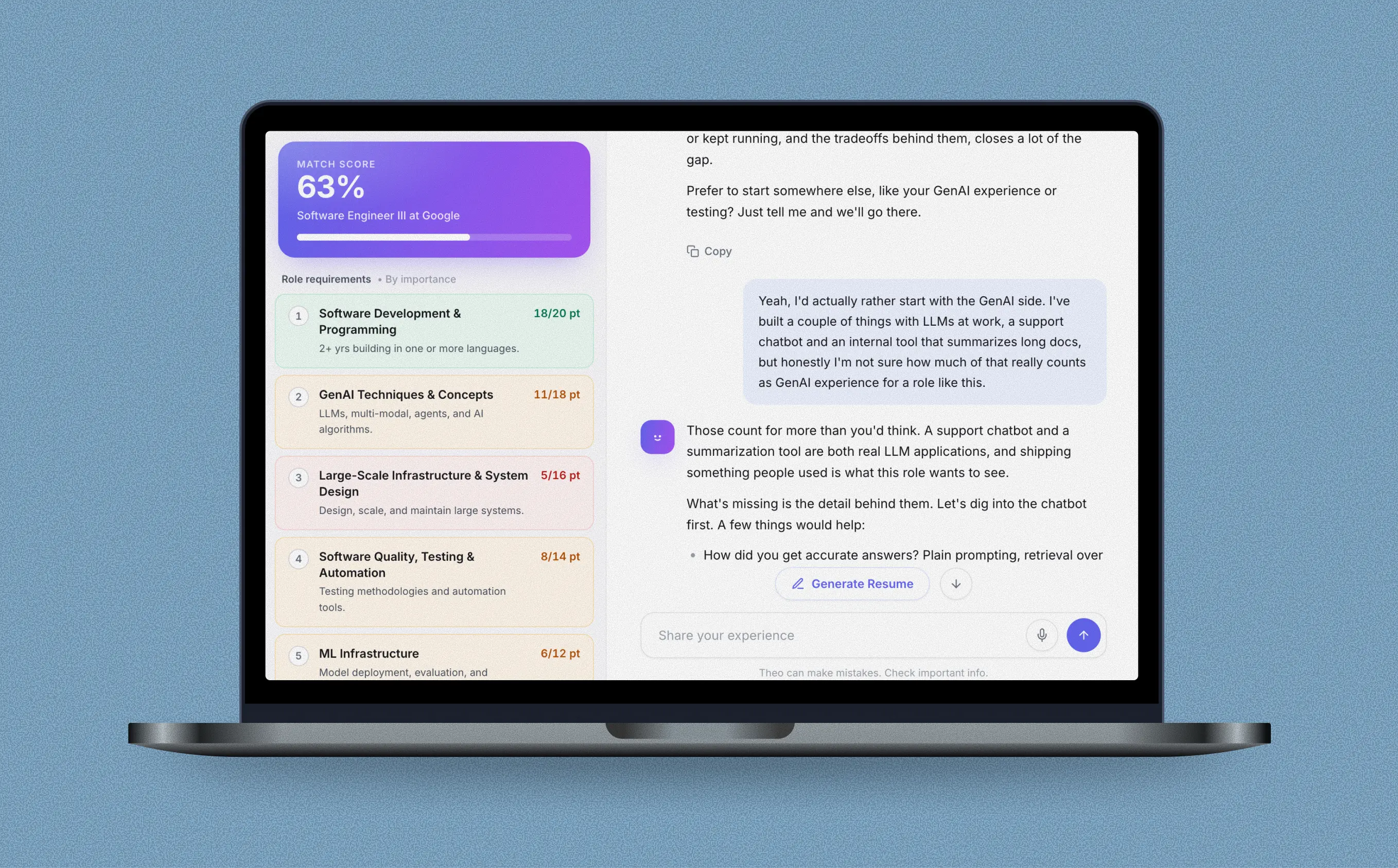
An AI resume workflow that makes job-fit gaps visible and easy to act on.
Core flow
1 · Set the target
Users upload a resume and job description, or just name the role, and get a match score with prioritized gaps. It answers the first question every applicant has: am I even qualified?
2 · Build the evidence
A guided AI chat helps users recall experiences they'd left off, then turns them into resume-ready stories. It closes the “what do I include?” gap.
3 · Generate the resume
The strengthened content comes together into a polished, role-targeted draft, so users never get stuck on “how do I say this well?”
The starting point
The problem: our core value moment depended on an infrequent trigger
At the time, nSpire AI was centered around interview practice, built for early-career job seekers.
I reframed it as a timing and frequency problem. We needed an earlier, more frequent job-search moment where users could feel value.
The product bet
Resume prep was the earlier, more repeatable entry point
The instinct on the team was to deepen interview prep, our strongest feature. I argued for the opposite: instead of waiting for the interview, bet on the moment users were already in, getting ready to apply.
The core insight
Users needed more than wording; they needed to know what counted
Choosing resume prep told me where to help. The interviews I ran told me what to fix.
| What users said | What it meant for the product |
|---|---|
| "I'm not sure if I'm qualified. | Show the match |
| "I don't know what to include. | Uncover what they'd forgotten |
| "I don't know how to say it well. | Sharpen the evidence |
Product direction
Show users where they stand, surface missing evidence, and help them turn relevant experiences into a stronger resume.
Design principles
The rules I designed against
01
Make the next step obvious
02
Balance guidance and control
03
Make progress visible
04
Don't fragment the resume
Design iteration · Decision 01
Structuring an AI chat that guides without taking over
An open chat leaves users lost. A rigid flow leaves them trapped. I weighed three structures against this tension.
Options explored
Idea 01
AI surfaces one gap at a time. Users address it or skip.
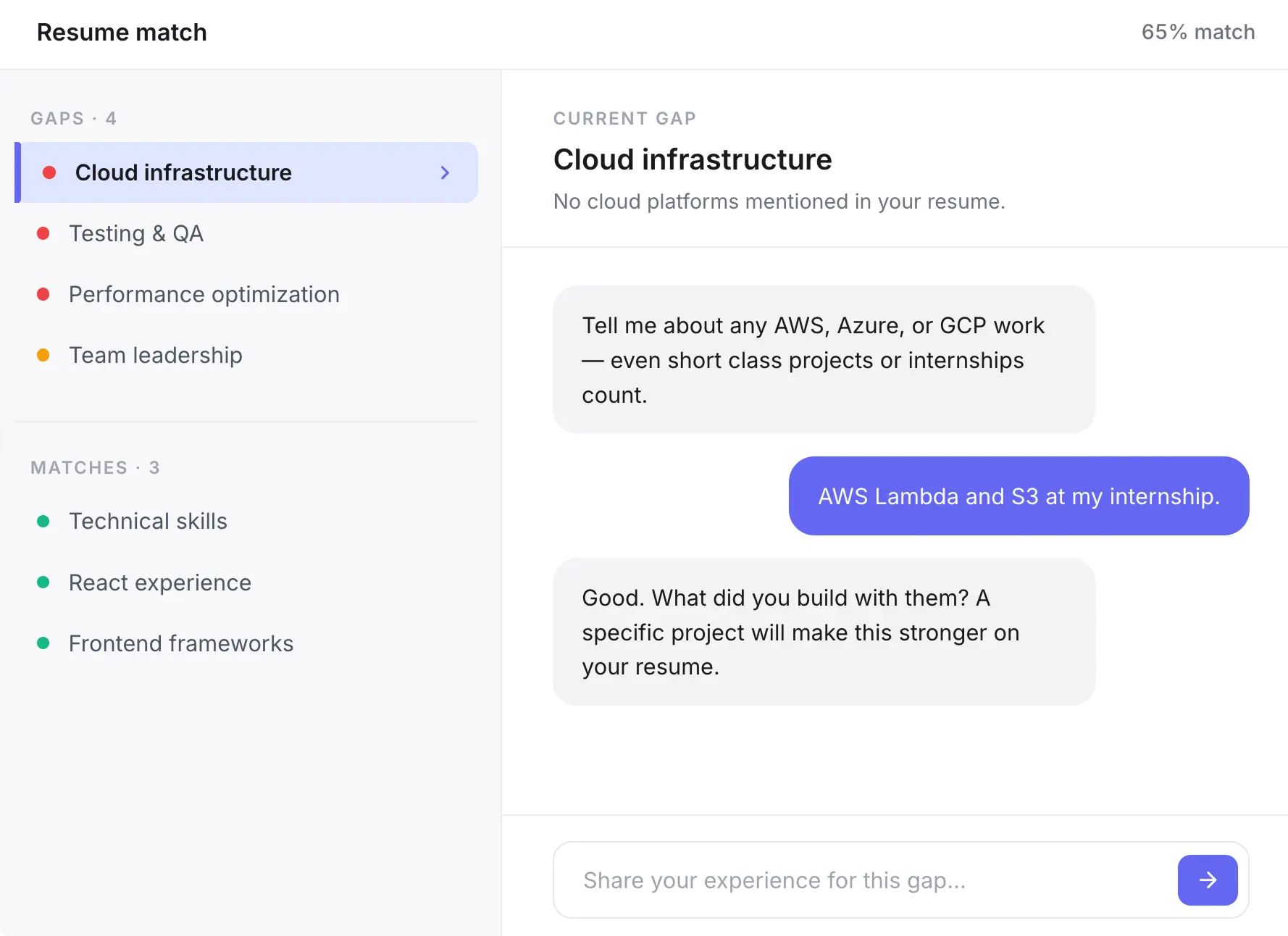
Users had to trust the AI's pick without seeing what else was on the table.
Idea 02
Clickable gap list. Selecting a gap opens its own scoped chat.
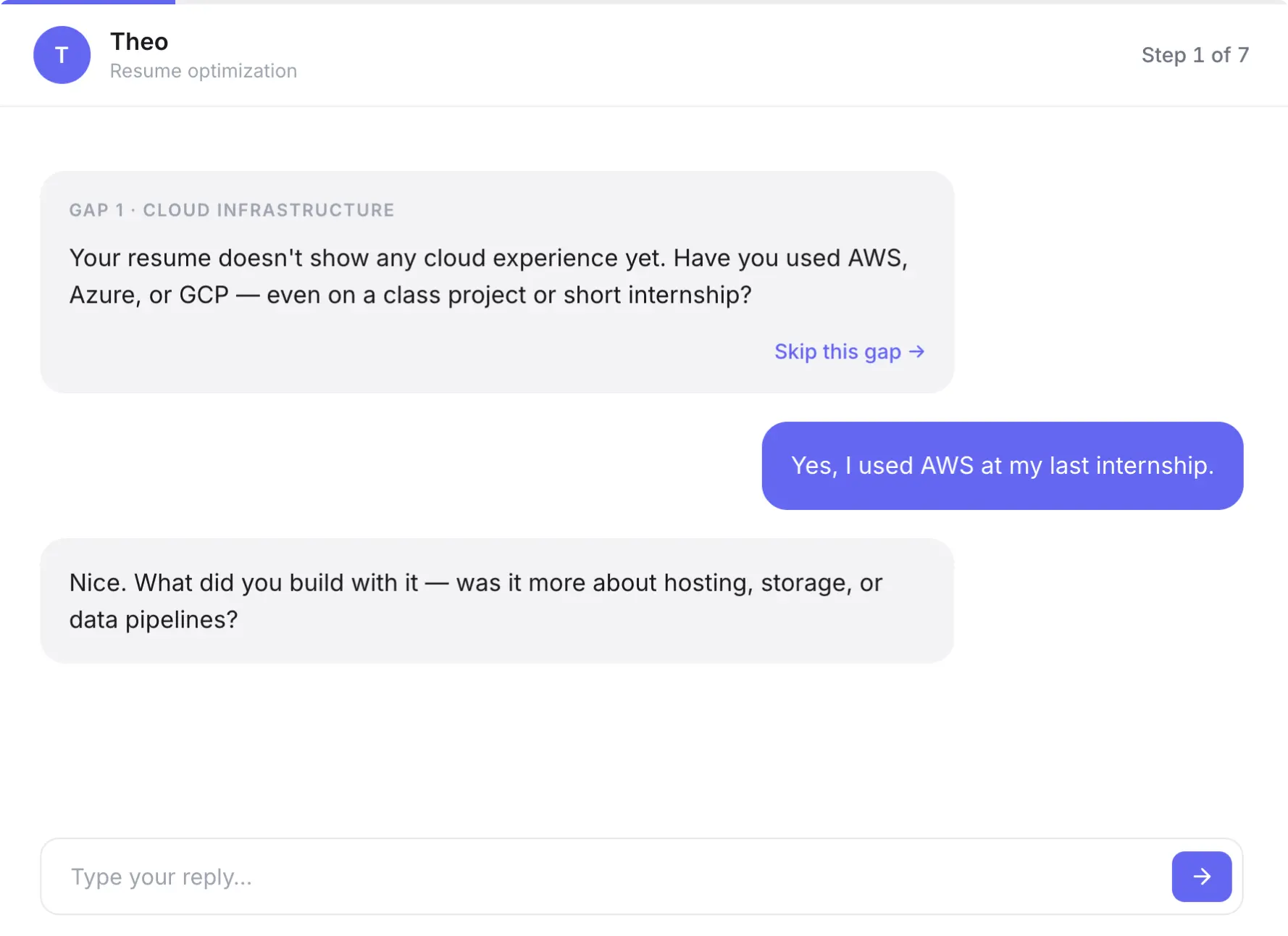
Real conversation rarely stays inside the structure you draw for it.
Direction chosen
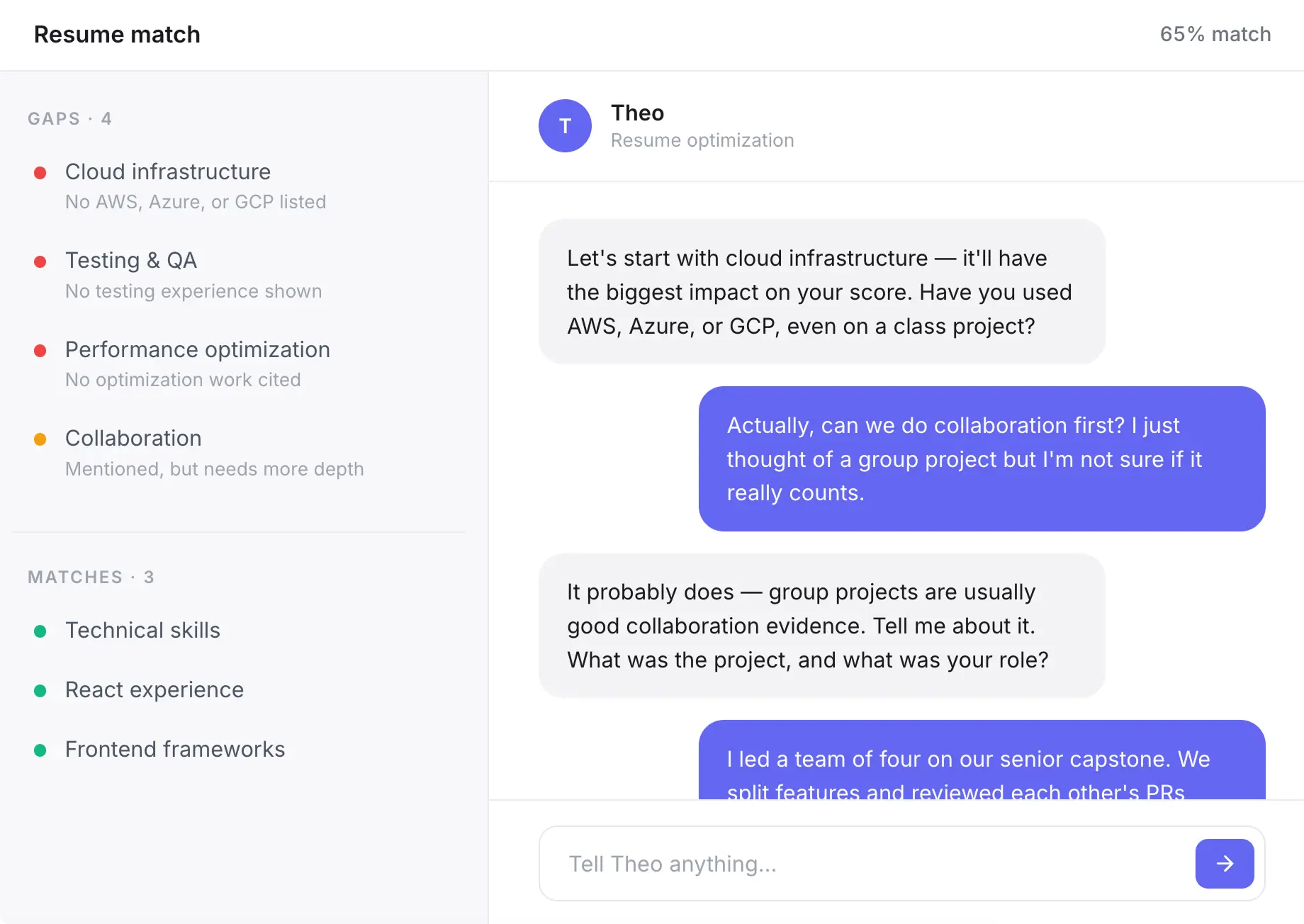
Idea 03
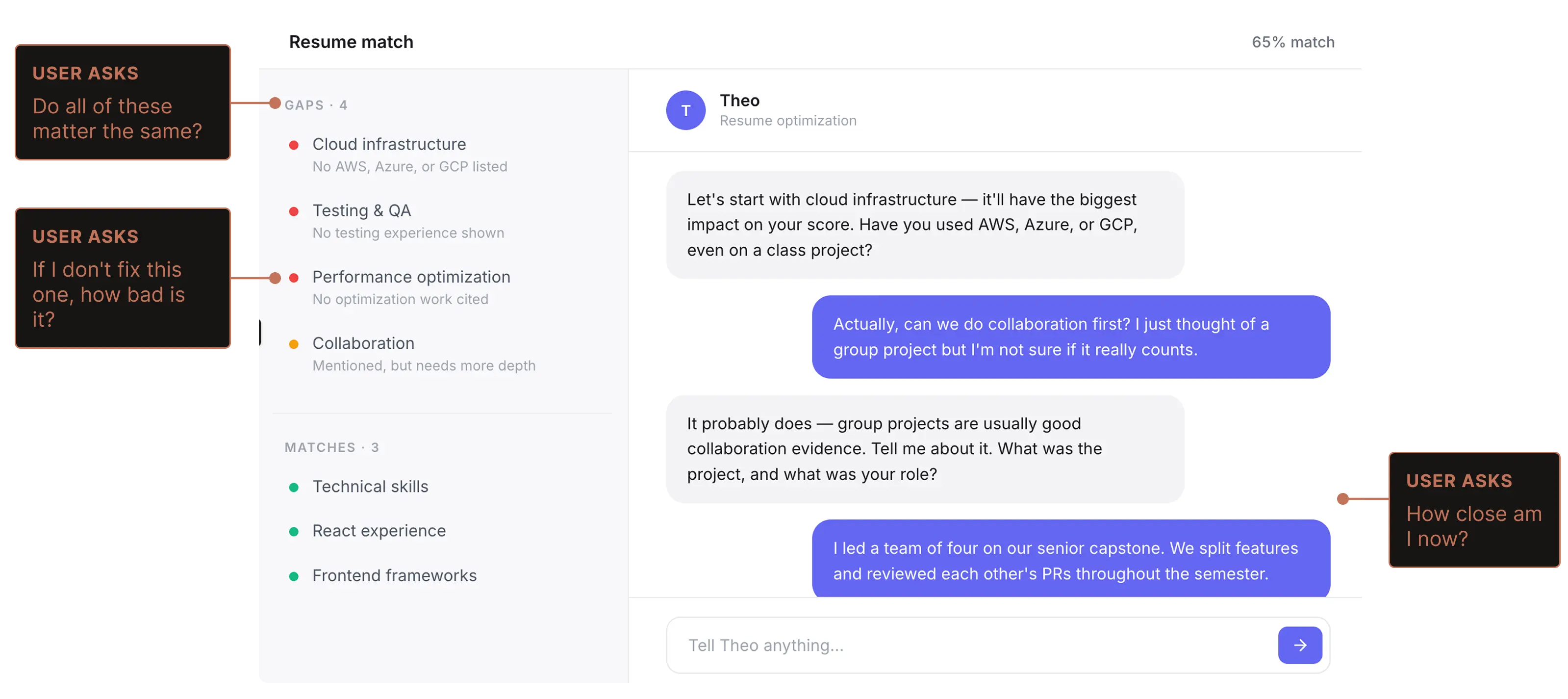
Gap panel on the left for visibility. One continuous chat on the right. AI starts on the highest-priority gap; users can redirect freely.
The panel kept the full picture visible. The continuous chat let the conversation follow how users actually think.
Design iteration · Decision 02
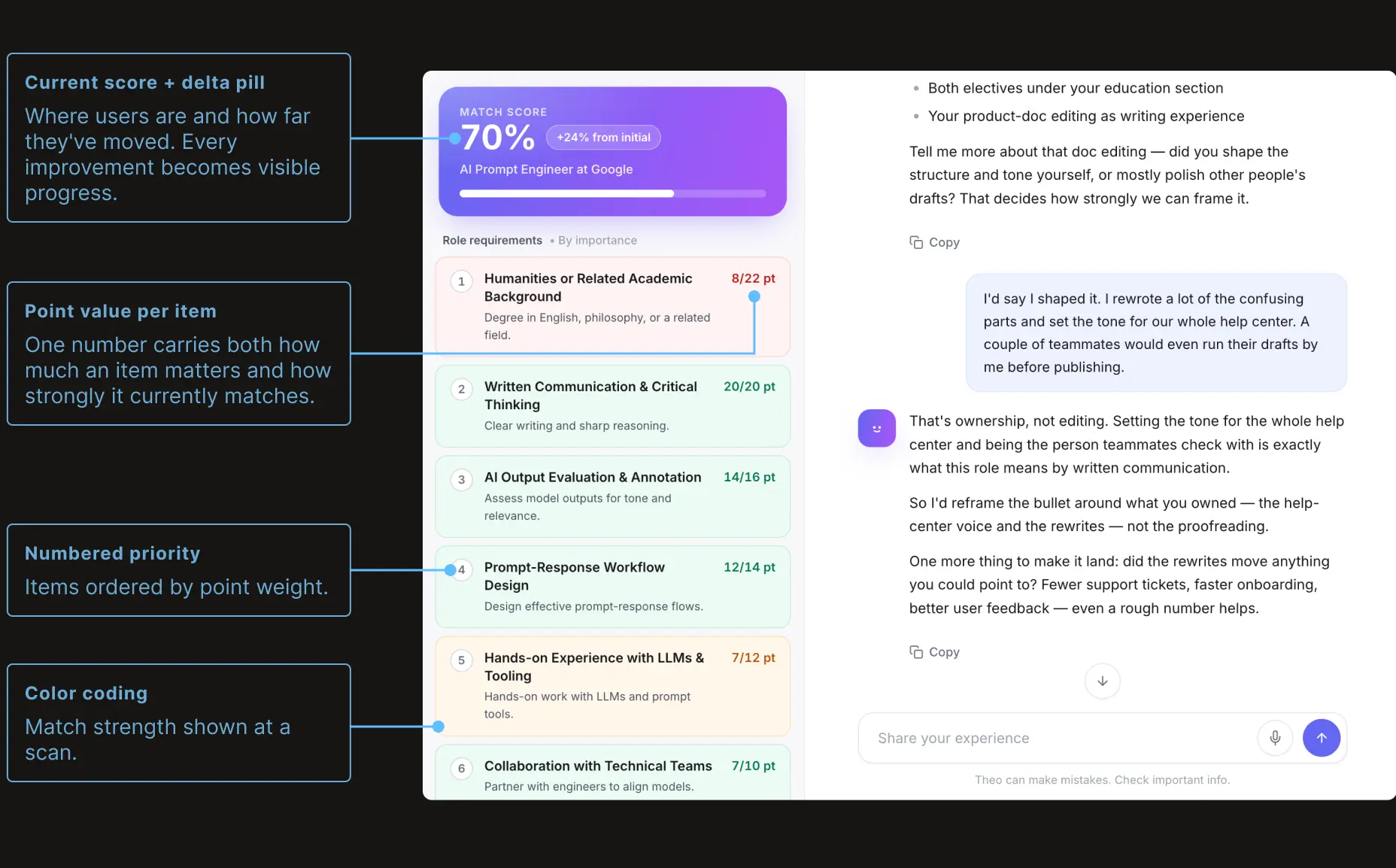
Making AI prioritization legible and motivating
Users liked seeing their gaps and matches, but to act on them they needed more than a list.
Options explored
Star rating
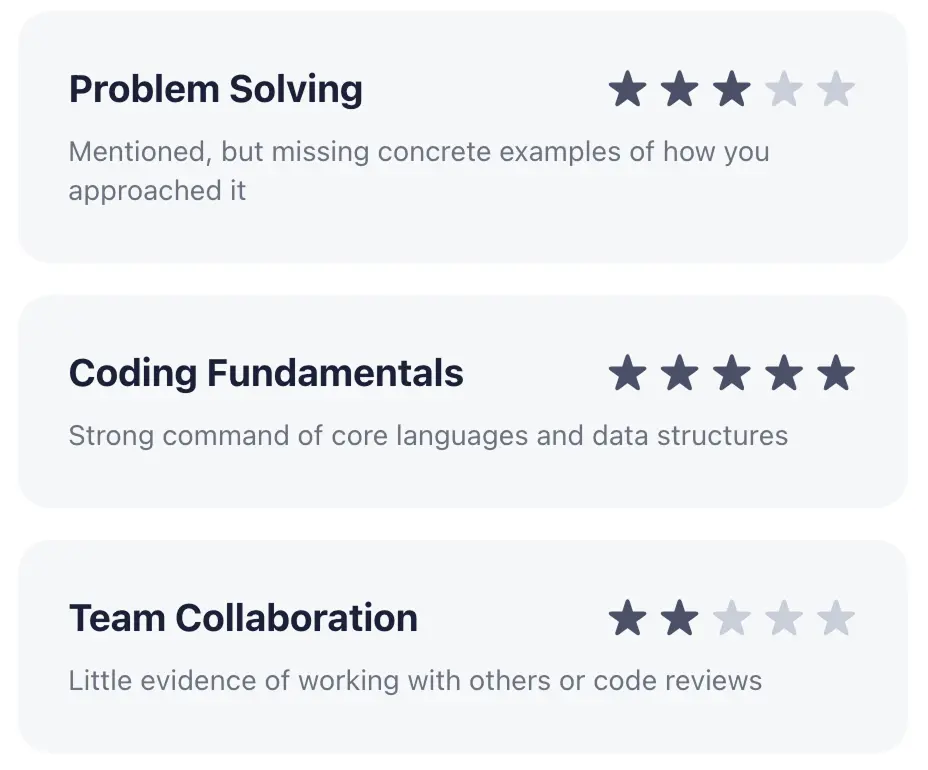
Encoded match strength. But a rating in isolation couldn't show what improving one star would do to overall fit.
Progress bar
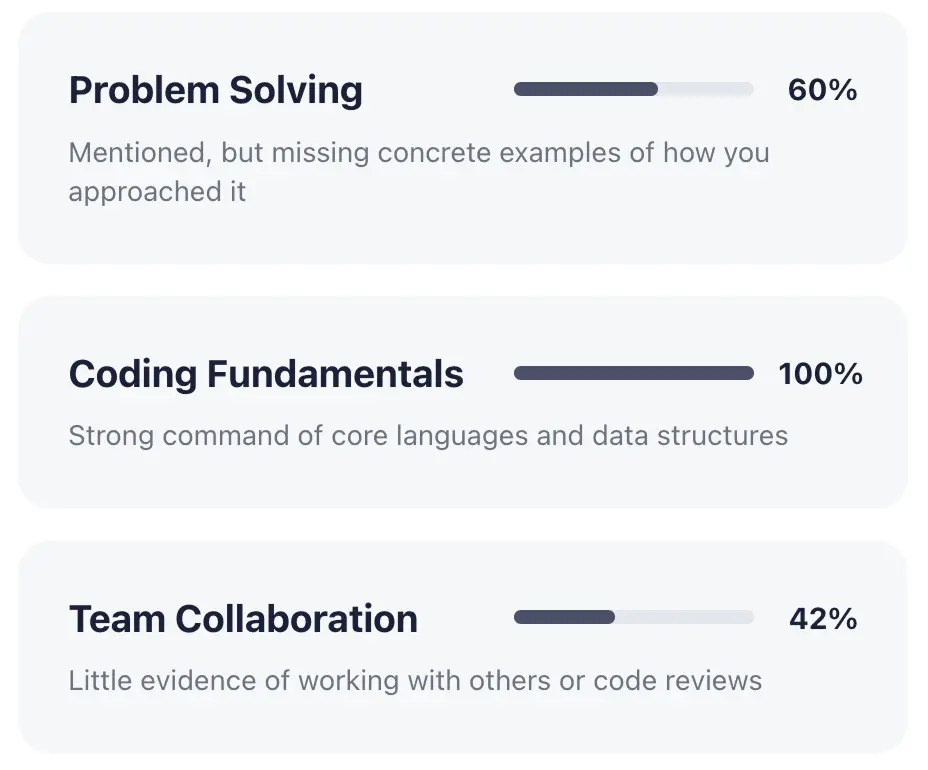
Encoded effort spent. But a full bar on a low-priority gap looked the same as one on a high-priority gap.
Ordered list
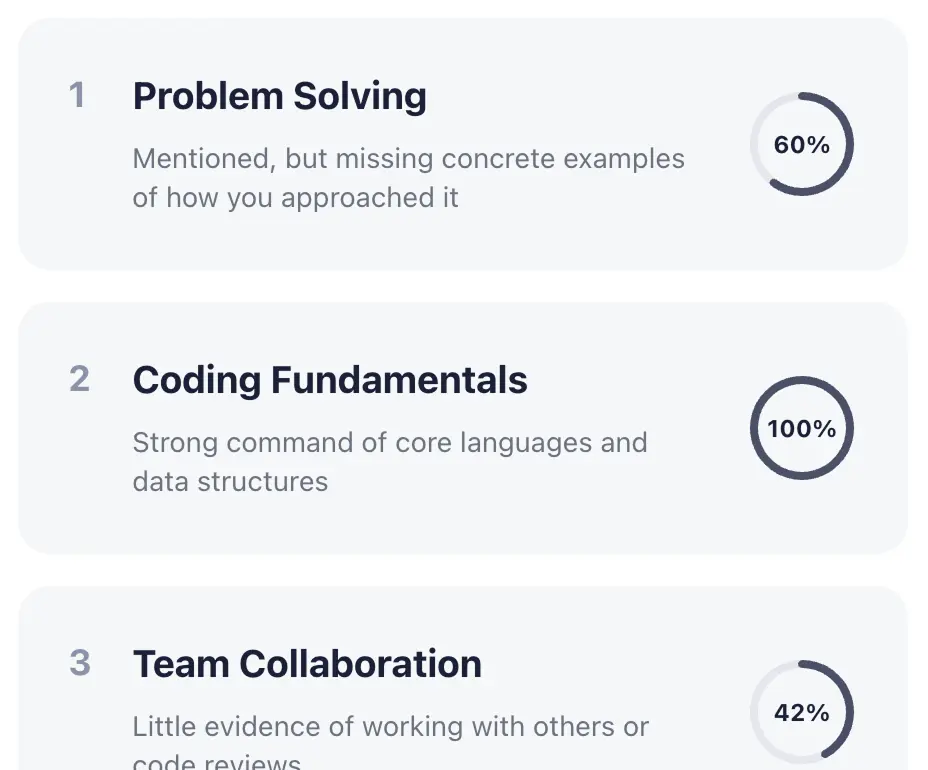
Encoded rank, not magnitude. Users couldn't tell if #2 was nearly as important as #1, or far less.
What shipped
Points toward a total score carried weight, priority, status, and progress at once.
Design iteration · Decision 03
Scoping what the AI should generate
One bullet at a time, or the whole resume? The scope decided what the AI could see, and what users had to carry.
Options explored
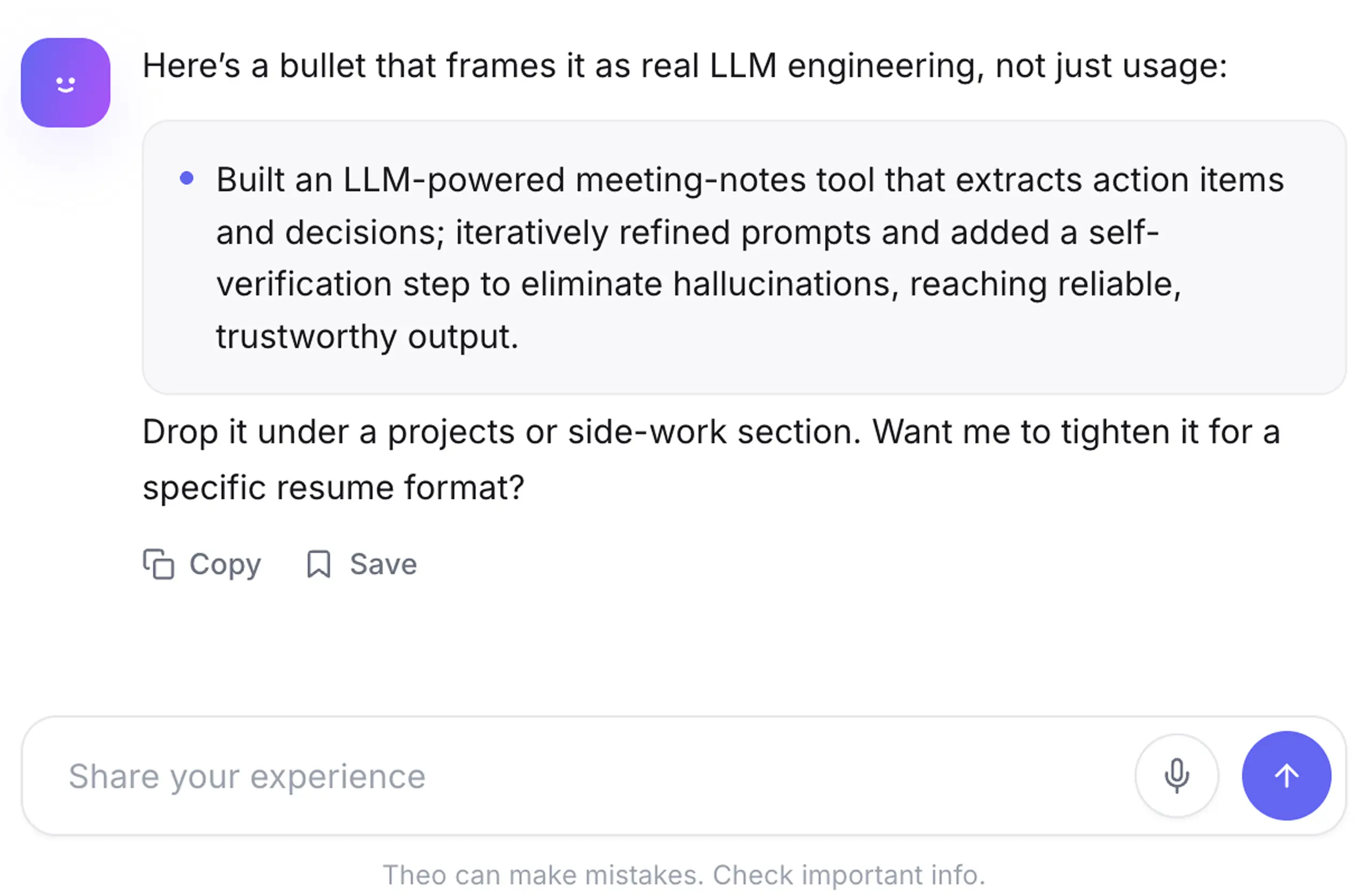
Idea 01
AI generates one bullet at a time.
Idea 02
AI generates the whole resume in one pass.
Comparison
| Bullet-by-bullet | Full resume Shipped | |
|---|---|---|
| What the AI controls | One bullet at a time. Has the user's resume as context, but no say in what gets cut, combined, or emphasized across the whole. | The whole resume. Can balance content, avoid duplication, and weight what matters for the role. |
| What users still have to do | Decide what to keep, cut, and combine on their own, the editorial work early-career users need help with most. | Light polishing if they want it, like adjusting a phrase to sound more like them. |
| Time to ship | Fast. Narrow scope, simpler prompts. | Heavier. Required a system that reasoned across the resume. |
The tradeoff
In V1, generating the whole resume meant users couldn't iterate on a single bullet alone. I accepted that cost. Bullet quality, and how bullets work together, depends on a holistic view of the resume.
The reception
What users said
I find it more useful than other tools I have tried (such as Job Scan), especially in providing specific, non-generic feedback.
The chat-based optimization felt accurate and useful. It made my resume more specific and ATS-friendly.
The detailed scoring plus suggestions helped me know exactly where to improve.